
sFPDP board: a rising star in adaptative optics
TECHWAY sFPDP board selected for real-time adaptive optics at the VLT.
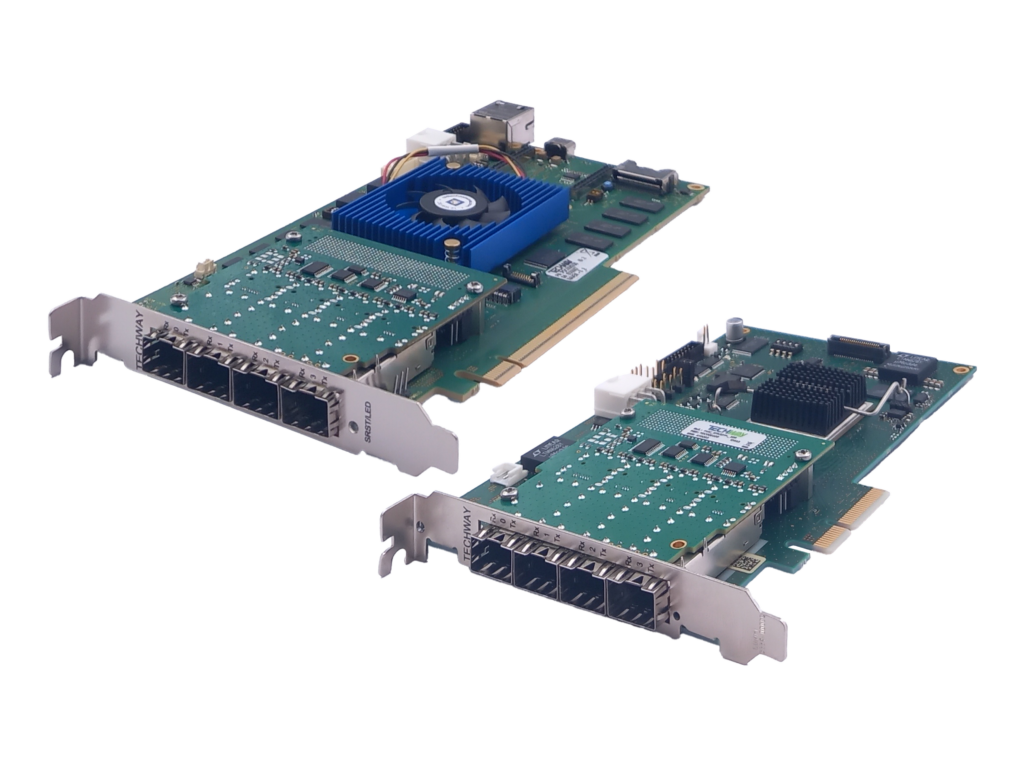
TECHWAY’s RAVEN-I sFPDP board has been selected for an adaptive optics upgrade of the SPHERE instrument at ESO’s Very Large Telescope (VLT). Called SAXO+, this upgrade, adds a second stage of optical correction to improve the instrument sensitivity for the direct imaging and characterization of exoplanets and circumstellar disks. RAVEN-I provides the sFPDP interface between the new real-time controller prototype and existing adaptive optics stage. The Observatoire de Paris published the integration and test results, demonstrating stable acquisition timing and the use of the TECHWAY’s API for real-time acquisition.
As a matter of fact, sFPDP has been a foundational technology for AO systems in astronomy, for real-time, high-bandwidth data transfer between components such as wavefront sensors (WFS), deformable mirror (DM) controllers, and dedicated real-time computer systems.
sFPDP links detectors to real-time controlers
Adaptive optics systems depend on fast, predictable data transfers to turn incoming measurements into optical corrections. With low latency and minimal protocol overhead, sFPDP supports these demanding exchanges between detectors, processing boards and real-time controllers.
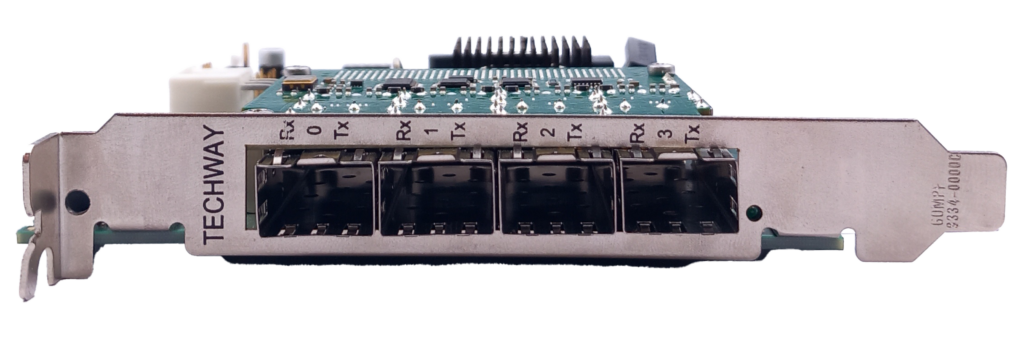
The Rising STARS report illustrates these uses in astronomy:
- GRAVITY+ at the VLTI: transferring infrared detector pixels to a real-time controller – “interface to transfer pixel data”
- SPHERE at the VLT: continuously delivering wavefront sensor data for processing – “Real-Time Data Streaming”
- SPARTA, SPHERE’s real-time control platform: distributing data between processing boards to calculate optical corrections – “low-latency data distribution”
Hardware performance demonstrated through testing
Tests with ESO’s SPARTA CODE Test Tool confirmed that RAVEN-I received the transmitted data “without any loss and in the right order”. Separate optical loopback tests at 1 kHz demonstrated excellent timing stability, with an average jitter of 0.11 µs and a maximum measured jitter of 0.17 µs under the test conditions. The report concludes: “These tests confirm the board’s capability to handle real-time data acquisition in a stable manner.”
Software integration with TECHWAY’s sFPDP board API
Using TECHWAY’s sFPDP board API, the team developed a C++ application for real-time acquisition, sequence checks, reception timestamps and data logging. This provides a practical example of the hardware and software working together within a demanding scientific application. These tests results feature in the European Rising STARS report on control systems for Space Situational Awareness (SSA), supporting preparations for adaptive optics experiments in Antarctica. For developers of real-time acquisition systems, this work provides a concrete reference for TECHWAY’s sFPDP board : demonstrated timing stability and successful application integration.